

Quanser QArm
Quanser QArm Research
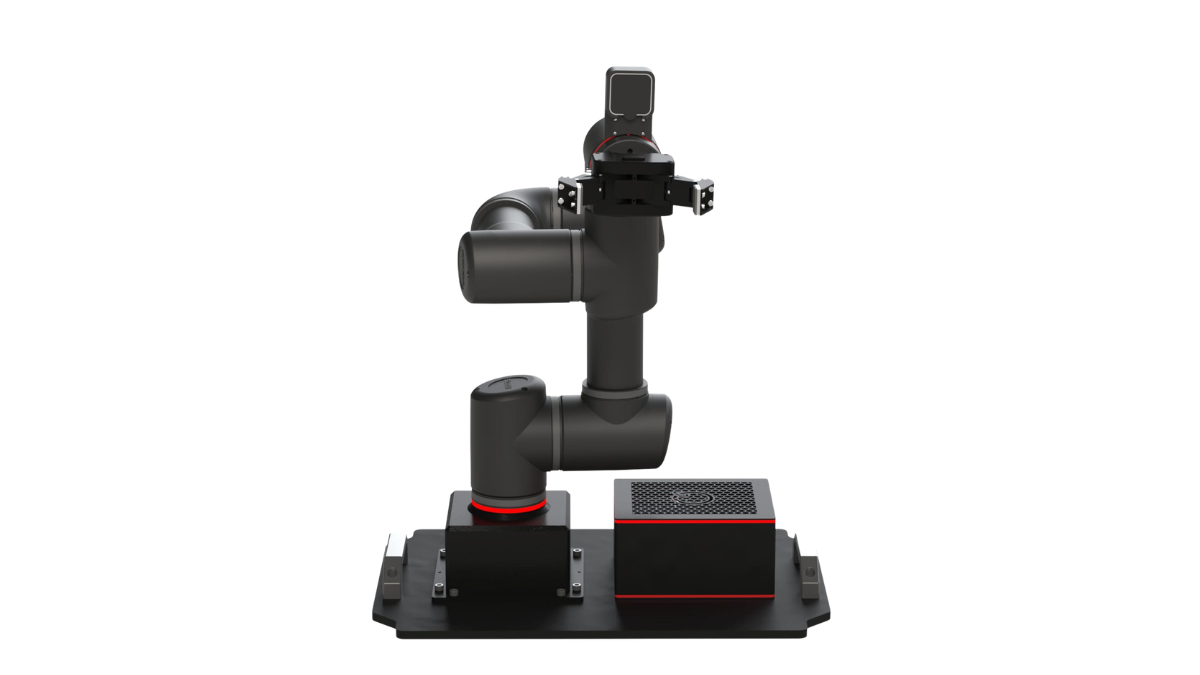
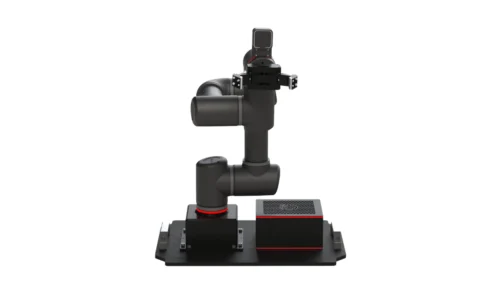
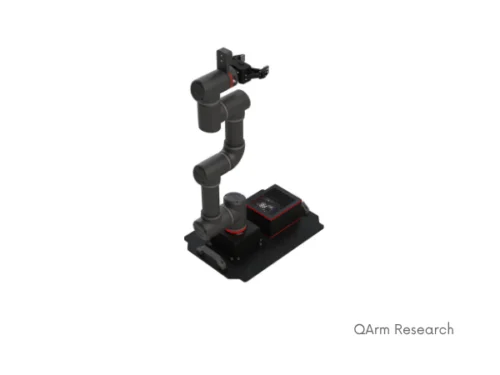
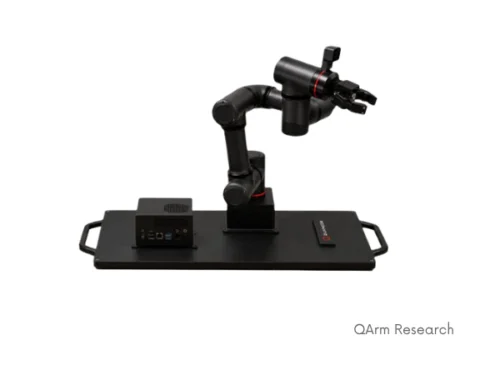
ResearchArm is a precision 6-axis robotic arm designed for advanced research and education in robotics and mechatronics. Its open architecture, high accuracy and repeatability, and NVIDIA-based platform enable projects in control systems, perception-based manipulation, imitation learning, reinforcement learning, and the implementation of artificial intelligence models.
SEND INQUIRY DOWNLOAD SPECIFICATION
INQUIRY
ResearchArm is a precision 6-axis robotic arm developed for advanced scientific research and education in robotics, mechatronics, and automation. The platform supports the full development lifecycle of control and manipulation algorithms, from modeling and simulation, through implementation and testing, to validation on a real physical system.
The manipulator is characterized by high positioning accuracy and repeatability, as well as an open architecture. Its integrated NVIDIA computing platform provides the performance required to implement algorithms based on machine vision, sensor data processing, and artificial intelligence models.
ResearchArm enables both research and teaching activities in classical control methods, motion planning, perception-driven manipulation, imitation learning, reinforcement learning, and the implementation and validation of AI models on a real robotic manipulator.
Thanks to its safe mechanical design, rich sensor suite, and compatibility with widely used research tools, the platform provides a complete environment for educational projects, scientific research, and the development of modern robotic manipulation control methods.
The product is also a part of Quanser Physical AI Lab and Intelligent Automation Lab.
What research areas can be explored with QArm Research?
QArm Research is designed for research in robotics, control, applied AI, and physical AI. It supports projects in manipulator control, motion planning, perception-driven manipulation, imitation learning, reinforcement learning, and the deployment and validation of AI models on a physical robot.
What control capabilities does the open architecture provide?
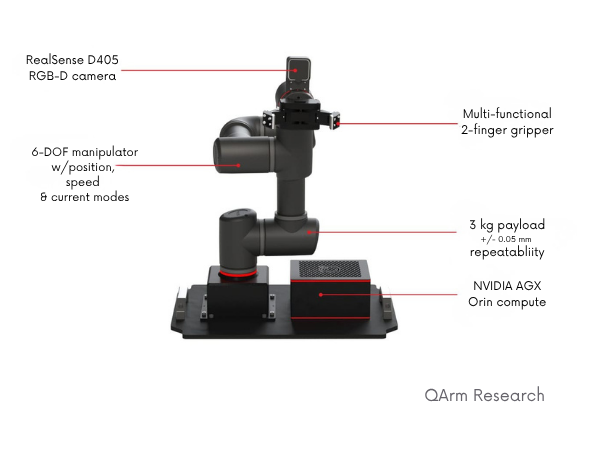
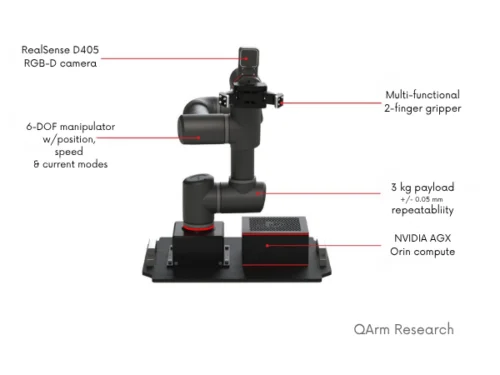
The platform provides access to current, velocity, and position control loops, allowing researchers to implement and test their own control algorithms. Its open architecture and flexible I/O also support the integration of additional sensors and actuators.
Which programming and simulation environments are supported?
QArm Research supports MATLAB®/Simulink®, Python®, ROS 2™, and C++. NVIDIA Isaac Sim® and NVIDIA Isaac Lab can be used for simulation and physical AI workflows, while Quanser Interactive Labs provides a digital twin of the manipulator. This makes it possible to connect modelling, simulation, training, and experiments on physical hardware within one workflow.
Can QArm Research be used for computer vision and AI projects?
Yes. The manipulator includes an Intel RealSense D405 RGB-D camera and a QBrain computing node based on NVIDIA AGX Orin. This configuration supports local sensor processing and research in perception, object recognition, vision-guided manipulation, and AI model deployment directly on the robotic platform.
Can QArm Research be integrated into a larger robotics laboratory?
Yes. QArm Research can operate as a standalone research platform or as part of larger Quanser laboratory solutions, including the Physical AI Lab and Intelligent Automation Lab. It can be integrated with the Haptic Robot, QBot Platform mobile robots, conveyors, and additional sensing systems to create more complex robotic research environments.