
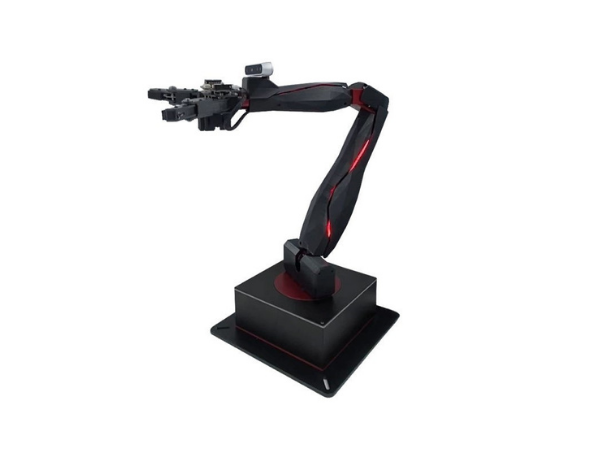
Quanser QArm
Quanser QArm
QArm is a robotic arm created with education and scientific research in mind. Like all experiments from Quanser, the arm was built with a completely open archiecture. The user has access to all internal signals, so they can freely create their own control and data processing algorithms. The product provides support of Matlab/Simulnik and Open-Source tools such as Robot Operating System (ROS). A built-in gripper and an RGBD camera make the robotic arm a multi-purpose tool.
The producer also offers a digital twin of this robotic arm that can be used at home. It’s a great solution for scientists who don’t have constant access to a laboratory and for students learning at home.
The arm is also available in a virtual version: (click here)
SEND INQUIRY DOWNLOAD SPECIFICATION
INQUIRY
Quanser QArm is a 4-DOF robotic manipulator designed for teaching and research in robotics, control, and mechatronics. Its open architecture provides access to robot signals and allows users to implement their own control algorithms, making the platform suitable for both structured laboratory exercises and more advanced student or research projects. QArm can be used to study topics such as forward and inverse kinematics, position control, trajectory planning, and pick-and-place operations. The integrated gripper and Intel RealSense D415 RGB-D camera extend the platform with object localisation, image processing, and vision-based robot control.
The platform supports MATLAB®/Simulink® and ROS, which makes it suitable for laboratories focused on control systems, robotics, and mechatronic system programming. A digital twin is also available, allowing selected applications to be developed and tested in a virtual environment before they are deployed on the physical manipulator.
The Robot is available in two versions: with a built-in controller (direct connection via USB port to a computer) and with SPI interface to interface with any controller.
What teaching and research topics can be covered with Quanser QArm?
Quanser QArm can be used for teaching and research in manipulator robotics. It supports topics such as forward and inverse kinematics, joint control, trajectory planning, robot statics and dynamics, as well as pick-and-place tasks and vision-based applications
What does the open architecture of QArm provide?
The open architecture provides access to robot signals and allows users to implement their own control and data-processing algorithms. QArm can also be extended with additional sensors and actuators, making it suitable for student projects and research applications.
Which programming environments are supported?
QArm supports MATLAB®/Simulink®, Python, and ROS. This allows students and researchers to work with both graphical control design tools and programming environments commonly used in modern robotics.
Can QArm be used for vision-based robotics tasks?
Yes. QArm includes an Intel RealSense RGB-D camera that provides both image and depth information. This enables laboratory exercises and projects in areas such as object detection, localisation, inspection, and vision-guided robot control.
Can QArm be used for vision-based robotics tasks?
Yes. Quanser provides a digital twin of QArm through the QLabs environment. The virtual platform allows students and researchers to develop and test selected tasks outside the laboratory and then transfer them to the physical manipulator.


